
Is Your Dog Playing or Fighting? Signs Every Dog Parent Should Know

Blog banner with the text “Playing or Fighting? How to Tell the Difference” on a dark blue background. A circular photo shows two black dogs wrestling during group play on an outdoor turf area.
Dogs don't always play politely.
They chase each other. Wrestle. Growl. Show their teeth. Tackle one another. Grab ears. Mouth necks. Take turns pinning each other to the ground.
To a human watching from across the yard, perfectly healthy dog play can sometimes look a little alarming.
And the opposite can also happen.
Two dogs may not be openly fighting, but one may already be uncomfortable and asking for space in ways that are easy to miss.
For dog parents in Gainesville and anywhere dogs regularly interact with other dogs, learning to recognize the difference is an important part of keeping social experiences safe and positive.
The question isn't simply:
"Are they playing or fighting?"
A better question is:
"Are both dogs still choosing to participate?"
That distinction can tell you a lot.
Healthy Dog Play Can Look Rough
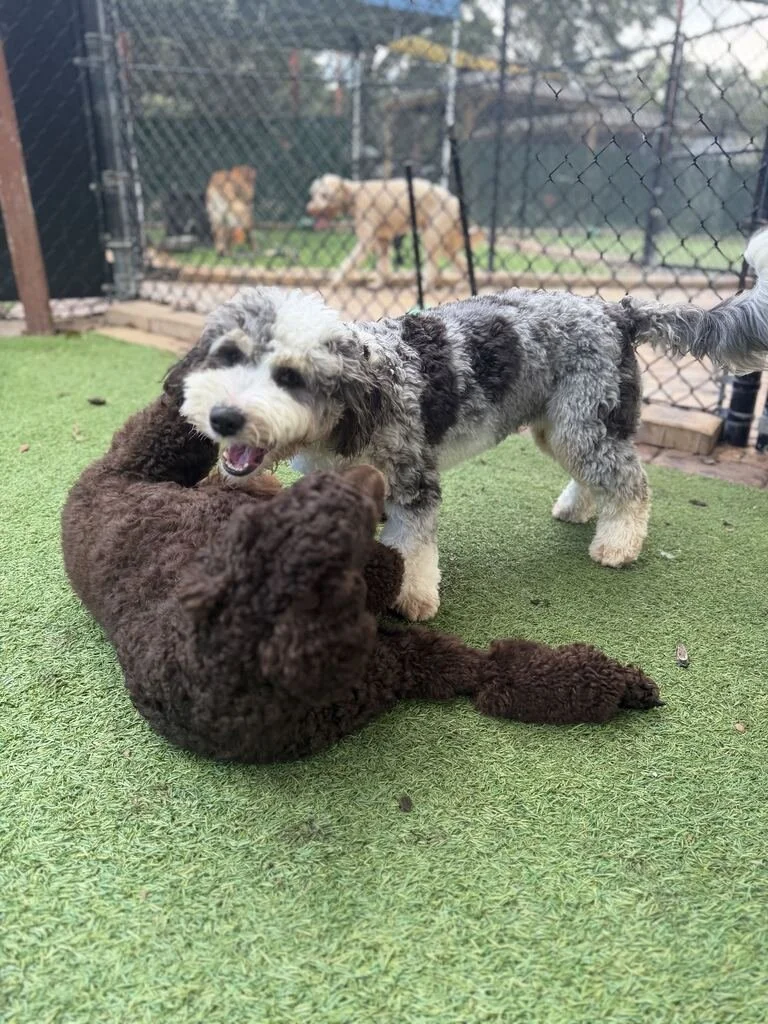
Humans sometimes expect dogs to play the way we would prefer them to: gently, quietly, and without much physical contact.
Dogs didn't get that memo.
Depending on their personalities and play styles, dogs may:
Chase each other
Wrestle
Growl
Bark
Mouth each other's faces or necks
Body bump
Roll around
Jump on one another
Play bow
Take turns being chased
Take turns being on top during wrestling
Some dogs are naturally very physical players.
Others prefer running and chasing.
Some enjoy brief interactions and then wander away to sniff.
None of those styles is automatically better than another.
What matters is whether the dogs understand each other and whether everyone involved is still having a good time.
The Most Important Sign: Reciprocity
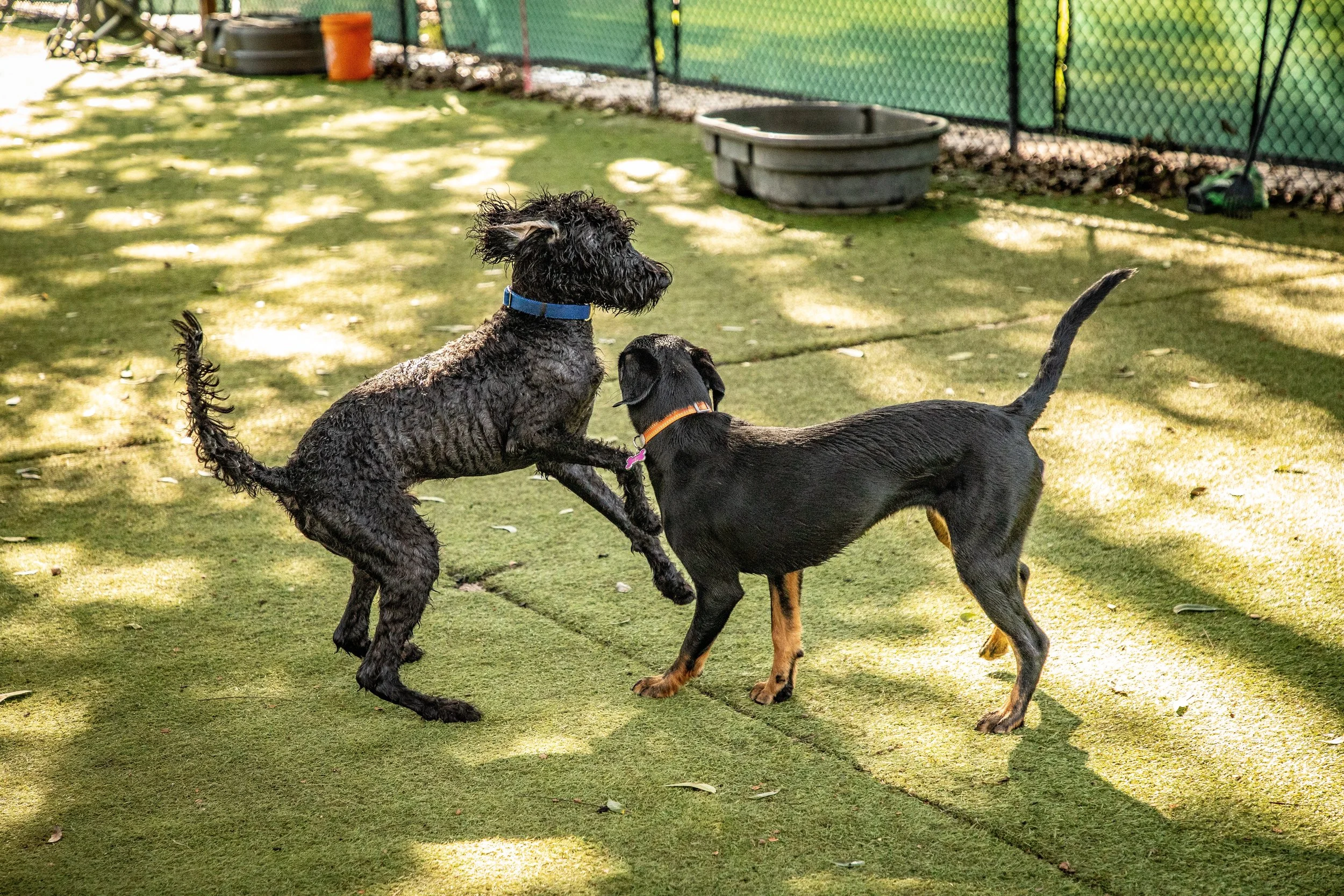
One of the first things we watch during dog-to-dog interaction is whether the play is reciprocal.
In other words:
Are both dogs participating?
During healthy play, roles often change.
One dog chases.
Then the other dog chases.
One dog is on top during wrestling.
A few moments later, positions switch.
One dog initiates.
Later, the other comes back and initiates again.
It doesn't need to be perfectly 50/50.
Some dogs naturally prefer being chased. Others enjoy being the wrestler who spends more time underneath.
The important part is that both dogs appear to have choice.
If one dog repeatedly tries to escape while the other keeps pursuing, that's very different from two dogs enthusiastically taking turns chasing one another.
Look for Loose Bodies, Not Just Wagging Tails
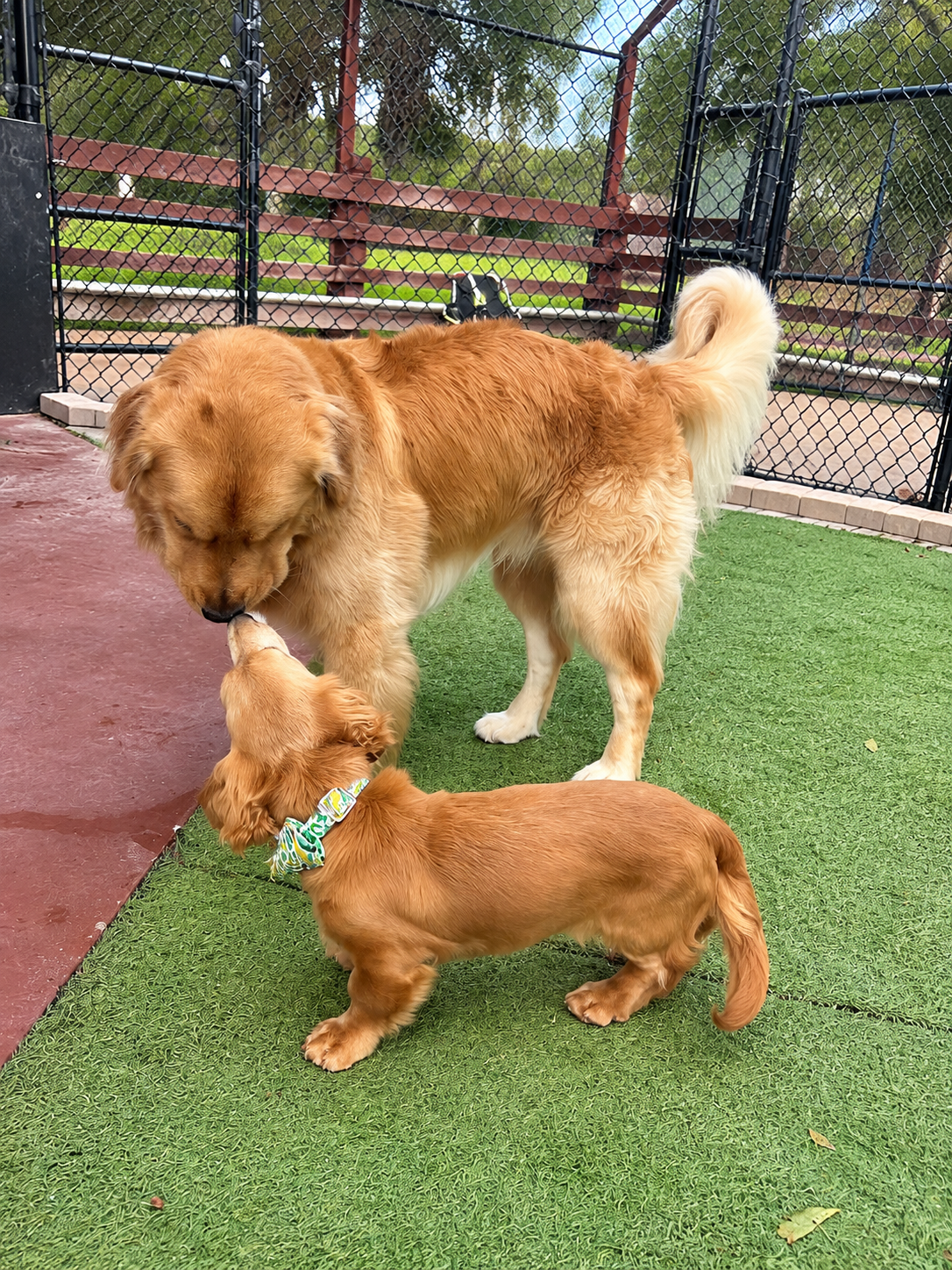
A wagging tail doesn't automatically mean a happy dog.
When watching play, look at the whole body.
Dogs enjoying an interaction often have loose, bouncy movements.
You may see:
Relaxed bodies
Curved movements
Open mouths
Exaggerated movements
Bouncy running
Play bows
Loose facial expressions
Natural pauses followed by re-engagement
Their movements may look almost silly.
That's very different from a dog whose body suddenly becomes rigid.
Stiffness deserves attention.
Watch for:
A tense or frozen body
Hard staring
A tightly closed mouth
Repeated attempts to move away
A tucked tail
Ears held tightly back
Hiding behind people or objects
Persistent avoidance
Increasingly intense vocalization accompanied by tension
One signal alone doesn't always tell the entire story.
Context matters.
That's why experienced supervision means watching the interaction as a whole rather than judging one bark, growl, or tail movement in isolation.
Play Bows Are Canine Punctuation
You have probably seen this one.
Front legs down.
Bottom in the air.
Tail up.
A dog may hold the position for a second before bouncing away.
That's the classic play bow.
Dogs often use play bows to communicate something similar to:
"This is play!"
A dog may even perform a play bow in the middle of an interaction that looks fairly rough.
Think of it as punctuation in the conversation.
The dogs may wrestle, mouth, chase, and tumble, and then one throws in a dramatic play bow before the game starts again.
It's one of many ways dogs communicate their intentions to each other.
Healthy Play Has Pauses
This is one of the most useful things dog parents can learn to notice.
Good play isn't necessarily nonstop play.
Dogs may wrestle intensely for several seconds and then suddenly stop.
One sniffs the ground.
Another shakes their body.
Someone gets a drink.
They look around.
Then, a few seconds later, one dog approaches again and the game resumes.
Those pauses are valuable.
They allow dogs to regulate their excitement and give each participant an opportunity to decide whether they want to continue.
If both dogs voluntarily return?
That's useful information.
They're essentially saying:
"Okay. Again!"
The Consent Test: What Happens When Play Stops?
If you're uncertain whether two dogs are enjoying an interaction, a brief pause can tell you quite a lot.
Separate or calmly interrupt the dogs for a moment.
Then observe.
Does the dog you were worried about:
Move back toward the other dog?
Initiate another chase?
Play bow?
Nudge the other dog?
Try to restart the interaction?
If so, they may have been enjoying the play even if it looked rough to you.
But if that dog:
Walks away
Hides
Stays close to a person
Avoids the other dog
Moves toward an exit
Appears relieved to have space
they may be telling you:
"I'm done."
That choice should be respected.
Growling Doesn't Automatically Mean Fighting
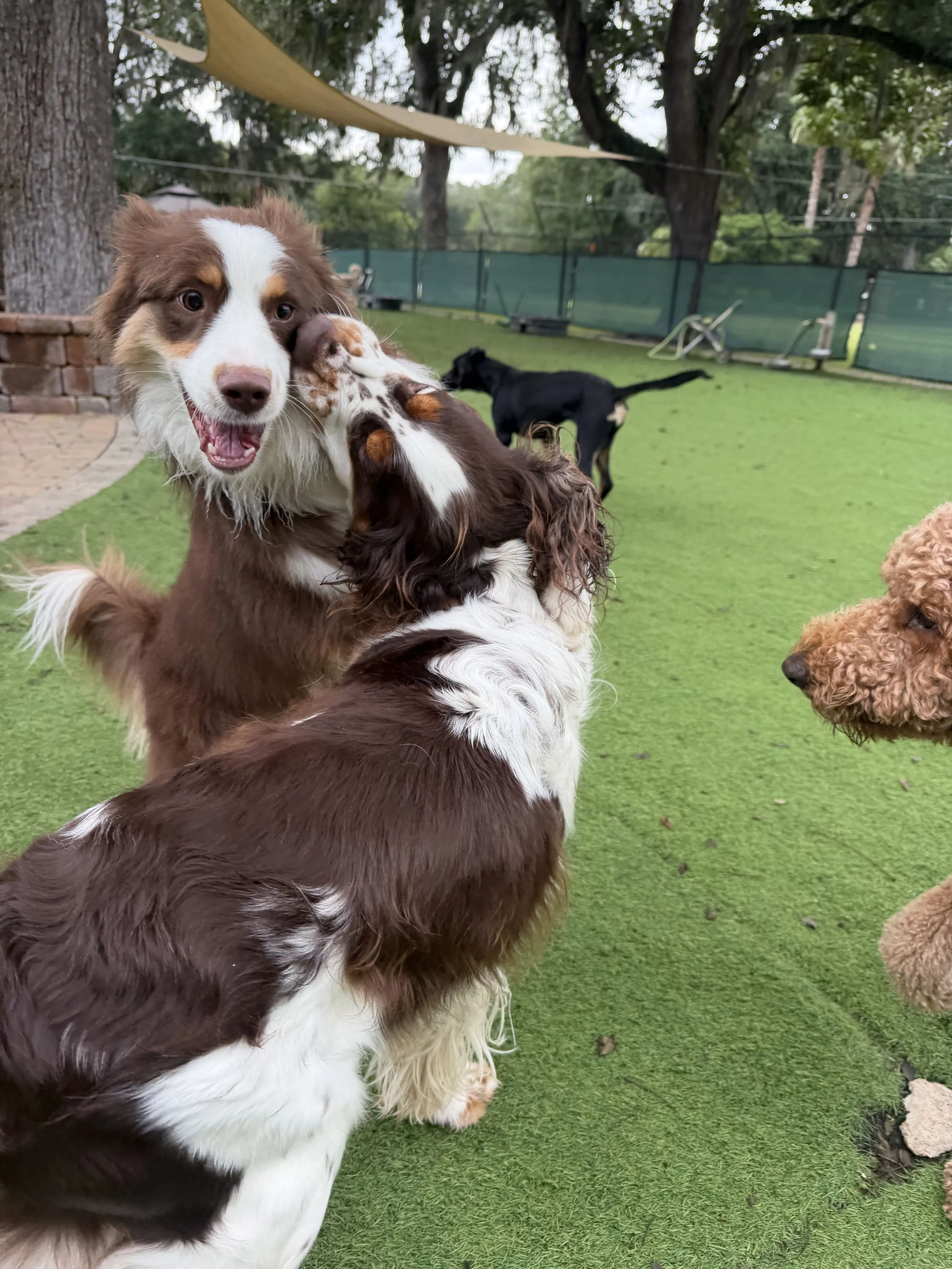
This surprises many dog parents.
Dogs can growl while playing.
Some dogs are extremely vocal players. They may growl, bark, grunt, or make sounds that seem dramatic while their bodies remain loose and their interaction remains reciprocal.
So don't evaluate a growl by sound alone.
Look at what the rest of the dog is doing.
A growling dog with a loose body who keeps bouncing back into reciprocal play presents a very different picture from a growling dog who has become stiff, frozen, intensely focused, or is trying to create distance.
The sound is only one part of the conversation.
What About Showing Teeth and Using Their Mouths?
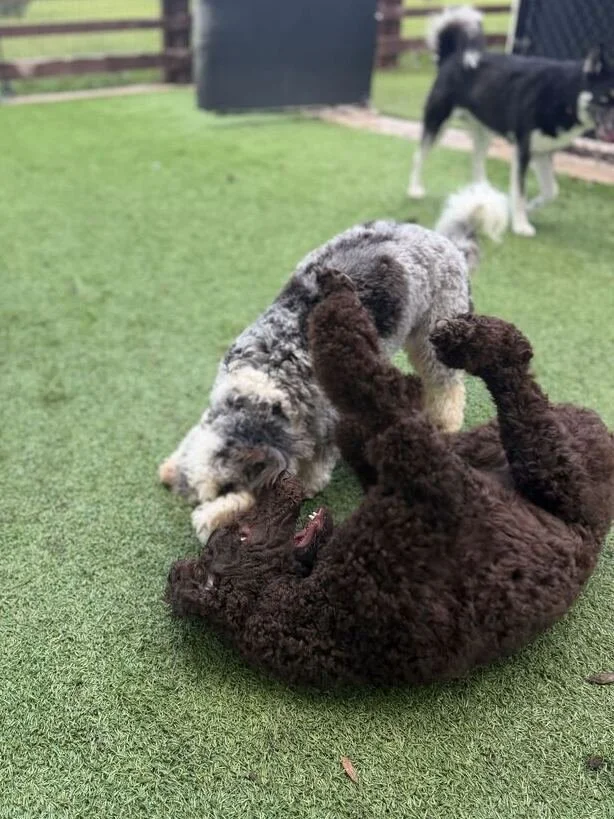
Dogs explore and communicate with their mouths.
During play, they may gently mouth another dog's neck, legs, cheeks, or ears. Some dogs also make dramatic facial expressions that expose their teeth.
Again, context is everything.
Look at:
Body tension
Intensity
Reciprocity
Whether the other dog keeps returning
Whether either dog is trying to escape
Whether the interaction responds to pauses
Mouthing during mutually enjoyable play is very different from a dog repeatedly pursuing and grabbing another dog who is actively trying to disengage.
"No" Can Be Very Quiet
This may be the most important part of understanding canine play.
Dogs don't always communicate discomfort with a growl or snap.
Often, they start much more subtly.
A dog may say "I need space" by:
Turning their head away
Moving their body away
Walking away
Avoiding eye contact
Licking their lips
Yawning
Becoming suddenly still
Lowering their body
Tucking their tail
Trying to hide
Staying close to a trusted person
If those signals aren't respected, communication may become stronger.
The dog may growl.
Then snap.
Then, potentially, escalate further.
A growl isn't necessarily the beginning of communication.
Sometimes it's what happens after quieter communication hasn't worked.
When Play Becomes Too Much
Even dogs who genuinely like each other can become overstimulated.
A fun game can become too intense.
That's why good supervision doesn't mean waiting until a fight happens.
It means recognizing when an interaction is moving in the wrong direction before it gets there.
We become more cautious when we see things such as:
One dog constantly pursuing another
Repeated pinning without role reversal
One dog repeatedly trying to escape
Ignored requests for space
Increasing body stiffness
Fixated staring
Escalating intensity without natural breaks
One dog becoming overwhelmed
Multiple dogs focusing intensely on one dog
A dog who can no longer disengage or settle
At that point, the dogs may need a break.
And that's okay.
A break isn't a punishment.
It's part of helping dogs regulate themselves.
Excitement Can Change Behavior
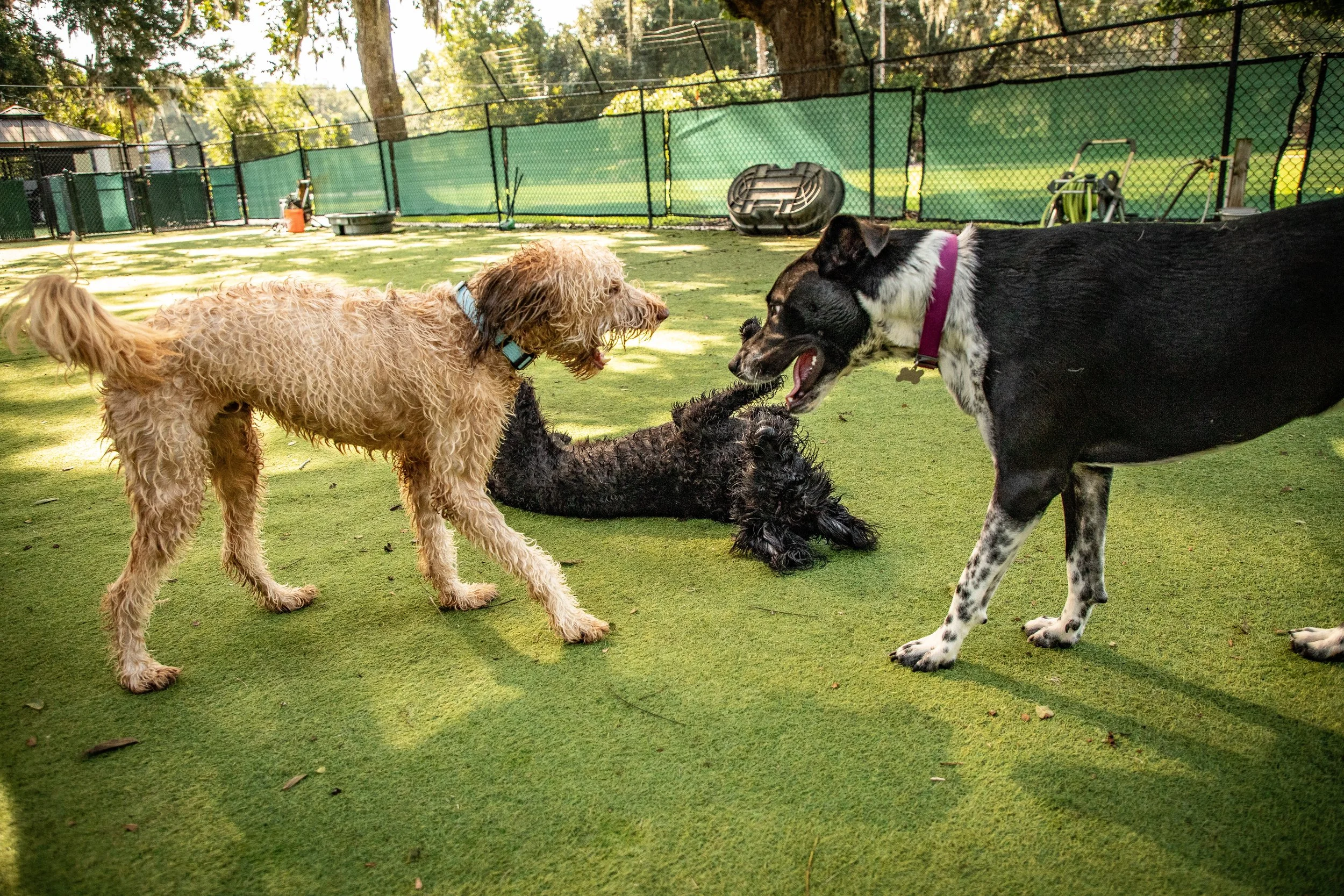
Dogs can become increasingly aroused during play.
The longer and more intense an interaction becomes, the harder it may become for some dogs to make good social decisions.
Think about children playing when everyone is tired and overexcited.
Everything may be going wonderfully.
Until suddenly it isn't.
Dogs can experience a similar escalation.
That's one reason structured rest and breaks are so important in a daycare environment.
The goal shouldn't be to keep dogs playing every minute they're there.
The goal is to create a day that balances:
social interaction + physical activity + mental stimulation + rest.
More activity isn't always better.
Not Every Dog Is a Match
Two perfectly friendly dogs can still be wrong for each other.
Imagine one dog who loves full-contact wrestling.
Now pair them with a dog whose idea of a wonderful afternoon is slowly sniffing the perimeter of the yard.
Neither dog is doing anything wrong.
They simply speak different social languages.
That's why compatibility involves more than size or breed.
We consider things like:
Energy level
Play style
Confidence
Age
Physical ability
Communication style
Ability to respect boundaries
Ability to disengage
Ability to settle
Sometimes a large dog and a small dog communicate beautifully.
Sometimes two dogs of exactly the same size don't.
Compatibility is individual.
Supervision Means More Than Being Present
There's an important difference between dogs being watched and dogs being actively supervised.
Good supervision requires understanding what you're seeing.
Someone needs to notice:
"That dog keeps asking for space."
"These two are getting increasingly excited."
"She usually enjoys this, but she's done now."
"He's chasing, but the other dog isn't chasing back."
"They need a pause."
Intervening early is much easier than trying to stop an interaction after it has escalated.
What About Play at Home?
These same principles matter when dogs live together.
Even dogs who are best friends don't need to interact constantly.
Give each dog opportunities to:
Rest separately
Eat without pressure
Enjoy individual attention
Have personal space
Walk away from interaction
Sleep without being disturbed
If one dog repeatedly asks the other to play and the second dog keeps declining, help enforce that boundary.
Your quieter dog shouldn't always have to be the one saying no.
This becomes especially important when introducing a puppy to an adult or senior dog.
Your older dog may like the puppy.
That doesn't mean they want to entertain them all day.
When Should You Intervene?
You don't need to interrupt every growl or wrestling match.
But you should step in when one dog's ability to choose is disappearing.
Consider interrupting when:
One dog repeatedly tries to leave and can't
Signals asking for space are ignored
The interaction becomes increasingly stiff or intense
One dog appears frightened or overwhelmed
Play is completely one-sided
The dogs stop taking natural pauses
One dog becomes fixated on another
The interaction isn't de-escalating when one dog disengages
When possible, intervene before the situation becomes a confrontation.
Calmly create space.
Allow everyone to decompress.
Then decide whether interaction should resume.
Good Play Isn't About How It Looks. It's About How It Feels to Both Dogs.
Some of the healthiest dog friendships look incredibly dramatic.
There may be wrestling, growling, chasing, tumbling, and plenty of noise.
Other friendships look almost boring.
Two dogs sniff together.
Walk together.
Lie near each other.
Occasionally play for thirty seconds.
Then go back to doing their own thing.
Both can be wonderful.
At Jazz's Wonderland, we don't expect every dog to socialize the same way.
We watch the individual dog.
We pay attention to their communication, their preferences, their energy, and their boundaries.
Because successful socialization isn't about creating as much interaction as possible.
It's about creating positive interaction that both dogs are choosing.
The next time you watch two dogs playing, don't just ask:
"Does this look rough?"
Watch a little closer.
Are their bodies loose?
Are there pauses?
Do the roles change?
Are boundaries being respected?
And, most importantly:
When given the choice to stop, do both dogs choose to come back?
That's where the real conversation is happening.
Want to learn more about how your dog interacts with other dogs? Schedule a meet & greet with Jazz's Wonderland and let us get to know your pup.