
Does My Dog Need Another Dog? How to Know If a Second Dog Is Right
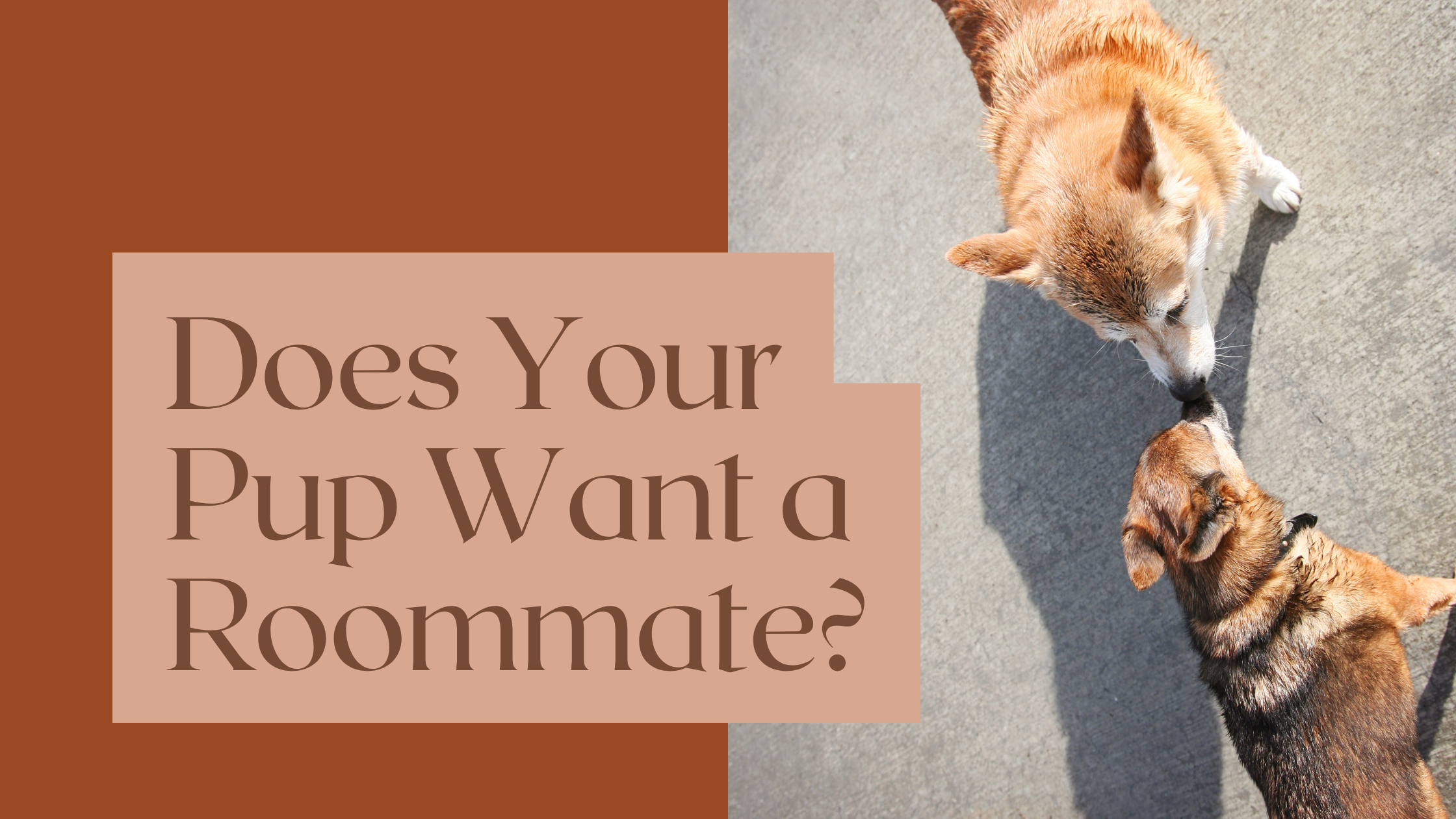
Blog banner featuring two dogs meeting nose-to-nose outdoors. Brown and beige graphic panels frame the image, with large text reading, “Does Your Pup Want a Roommate?” The design introduces a discussion about whether a dog may benefit from having another dog in the household.
If your dog loves playing with other pups, you may have found yourself wondering:
“Would my dog be happier if I got another dog?”
It’s an understandable question. We love our dogs, and the idea of giving them a built-in friend to play, nap, explore, and grow with sounds wonderful.
For some dogs, it truly can be.
For others, however, being the only dog in the household is exactly what makes them happiest.
Dogs are social animals, but being social doesn’t automatically mean wanting to share their home, humans, toys, food, and daily routine with another dog. Just like people, dogs have different personalities, social preferences, energy levels, and tolerance for company.
That’s why the decision to add a second dog should be about more than whether your current dog “likes other dogs.”
At Jazz’s Wonderland, we spend a lot of time observing how dogs communicate, play, rest, set boundaries, and respond to different personalities. One thing becomes very clear: there is no universal definition of the perfect canine friendship.
Before bringing home a new puppy or adopting an older dog, take some time to understand what your current dog is telling you—and what adding another dog would mean for your entire family.
First Things First: Does Your Dog Actually Want a Canine Companion?
A dog who enjoys daycare isn't necessarily asking you for a sibling.
This is an important distinction.
Some dogs absolutely love playing with friends for a few hours and then enjoy returning home, stretching out on their favorite bed, and having their humans—and their space—all to themselves.
Others seem to genuinely seek canine companionship. They form close relationships with particular dogs, frequently initiate appropriate play, relax comfortably around other dogs, and appear more confident when a compatible canine friend is nearby.
Neither personality is better than the other.
The goal is to recognize which dog you have.
Signs Your Dog May Enjoy Living With Another Dog
Your dog may be a good candidate for a canine housemate if they:
Consistently seek interaction with other dogs
Have a history of positive relationships with dogs
Play appropriately and respond to social cues
Can disengage from play and relax around another dog
Share space comfortably
Recover easily from exciting interactions
Show curiosity rather than tension when meeting unfamiliar dogs
Have particular dog friends they repeatedly seek out
Seem confident and comfortable in small, well-matched groups
One particularly positive sign is the ability to do nothing together.
Dogs who can play and then comfortably lie down near each other often demonstrate a level of compatibility that goes beyond excitement.
What About the “Lone Wolf” Dog?
Some dogs simply prefer people.
Others enjoy dogs occasionally but don't want them around all the time.
And some dogs actively find canine company stressful.
A dog may prefer being the only dog if they:
Frequently avoid other dogs
Become tense when dogs enter their personal space
Guard food, toys, resting places, or people
Prefer human interaction during social situations
Become overwhelmed during extended group play
Have difficulty settling when another dog is nearby
Regularly hide, leave, or seek escape from canine interaction
Have a history of conflict with dogs in the home
Are elderly, physically uncomfortable, or particularly attached to a quiet routine
These dogs aren't necessarily “antisocial.”
They simply have preferences.
A dog can live an incredibly rich life through relationships with people, walks, sniffing, training, enrichment, daycare when appropriate, and occasional interactions with carefully selected canine friends.
A second dog is not a requirement for a happy first dog.
Loving Daycare Doesn't Automatically Mean Wanting a Sibling
This is something pet parents should consider carefully.
Daycare and living together are very different social experiences.
At daycare, dogs have opportunities to interact in a supervised environment where personalities, energy levels, and play styles can be considered. They also receive breaks and have opportunities to decompress.
At home, another dog is there every day.
They may share:
Human attention
Living spaces
Doorways
Toys
Food-related environments
Resting areas
Backyard space
Daily routines
Your dog may adore a particular friend at daycare while still preferring to go home alone afterward.
Think of daycare as socializing with friends and living with another dog as having a roommate.
Enjoying one doesn't automatically mean wanting the other.
Look at Relationships, Not Just Play
When determining whether your dog might enjoy a companion, don't focus exclusively on how much they play.
Watch how they communicate.
Healthy canine interactions often include:
Reciprocal play: Both dogs take turns chasing, wrestling, or initiating interaction.
Self-handicapping: A larger or stronger dog may intentionally adjust their play for a smaller companion.
Play breaks: Dogs pause naturally rather than remaining constantly overstimulated.
Respect for boundaries: When one dog communicates “enough,” the other listens.
Relaxation: The dogs can exist together without needing constant interaction.
Recovery: Excitement doesn't escalate endlessly.
Sometimes the best potential housemate isn't the dog your pup plays with the hardest.
It may be the dog they can comfortably play with, communicate with, and relax beside.
Before Getting Another Dog, Ask Yourself Another Question
There are actually two separate questions:
Would my dog enjoy another dog?
and
Do I want another dog?
Both answers need to be yes.
A second dog means another individual with their own needs, veterinary expenses, food, grooming, training, exercise requirements, personality, and potentially unexpected behavioral or medical challenges.
Getting a dog solely to entertain your existing dog can create problems.
Your first dog may not want the responsibility—and the new dog deserves to be wanted as a member of the family in their own right.
Puppy or Adult/Senior Dog?
Once you've decided another dog may be right for your household, the next question is often:
Should we get a puppy or adopt an older dog?
There isn't one correct answer.
The best choice depends heavily on your current dog's personality, age, energy level, and tolerance.
Adding a Puppy: The Advantages
Puppies can bring enormous energy and joy into a household.
For an active, playful adult dog who genuinely enjoys younger dogs, a puppy may become an excellent companion.
Potential benefits include:
Your Current Dog May Help Model Household Routines
Puppies frequently observe other dogs.
A calm resident dog may help demonstrate everyday routines such as settling down, going outside, following household movement, and relaxing during quiet periods.
That doesn't replace training—but it can help.
Puppies Are Highly Adaptable
Because they're still developing socially, puppies can often adapt well to the household's existing routines when introduced thoughtfully.
Their Relationship Can Develop Gradually
A puppy and adult dog may build a relationship over many years.
For compatible dogs, that can become a wonderful bond.
But Puppies Are... Puppies
That adorable bundle of fluff comes with very little understanding of personal boundaries.
Puppies may:
Bite ears and tails
Jump on sleeping dogs
Steal toys
Interrupt rest
Demand constant play
Ignore warnings
Have accidents
Wake everyone up
Require substantial training
An adult dog who enjoys other dogs may still find a puppy incredibly annoying.
This is especially important with senior dogs.
Imagine being retired and suddenly receiving a hyperactive toddler as a roommate.
That's essentially what some senior dogs experience when families introduce puppies.
Your older dog shouldn't be expected to raise the puppy.
Adding an Adult or Senior Dog
Older dogs are sometimes overlooked when families consider getting a companion, but they can be wonderful additions to the right household.
One significant advantage is predictability.
With an adult dog, you often have a clearer picture of:
Personality
Energy level
Size
Play style
Social preferences
Exercise requirements
That can make compatibility easier to evaluate.
Why a Senior Dog May Be the Perfect Match
If your current dog is calm, mature, or older, another adult or senior dog may fit the household much more naturally than a puppy.
Two compatible older dogs may enjoy:
Leisurely walks
Sniffing together
Quiet companionship
Relaxing outdoors
Sleeping near each other
Gentle interaction
Friendship doesn't always look like wrestling across the backyard.
Sometimes it looks like two dogs peacefully napping six feet apart.
And that's still companionship.
Things to Consider Before Adopting a Senior Dog
Senior dogs may also come with additional responsibilities.
Depending on the individual dog, families should be prepared for:
Increased veterinary needs
Medication
Mobility changes
Dental care
Dietary requirements
More frequent bathroom breaks
Reduced tolerance for rough play
There is also an emotional consideration: adopting an older dog may mean having fewer years together.
But for many families, providing those years with comfort, stability, and companionship makes senior adoption extraordinarily rewarding.
Compatibility Matters More Than Age
Rather than beginning with:
“Should I get a puppy or senior dog?”
Try asking:
“What personality would complement the dog I already have?”
Consider:
Energy Level
A highly active dog may become frustrated with a companion who never wants to interact.
Conversely, a calm dog may feel overwhelmed by nonstop play.
Play Style
Some dogs love wrestling.
Others prefer chasing.
Some enjoy gentle interaction.
Others would rather sniff together and then nap.
Compatible play styles can make a significant difference.
Size
Size alone doesn't determine compatibility, but major differences can increase the risk of accidental injury during play.
Confidence
Two extremely intense personalities may clash, while pairing a confident but socially appropriate dog with a more reserved dog can sometimes work beautifully.
Resource Preferences
Consider how each dog behaves around food, toys, beds, attention, and personal space.
Age and Physical Ability
A dog's body matters as much as personality.
An arthritic senior may emotionally enjoy another dog while physically struggling with rough play.
Don't Forget Your Own Lifestyle
The ideal second dog isn't only compatible with your first dog.
They also need to be compatible with you.
Ask yourself:
Do I realistically have time to train two dogs?
Can I walk them separately when necessary?
Can I afford veterinary care for both?
Do I have enough physical space?
Can the dogs be separated safely when needed?
What happens if they don't become best friends?
Can I meet different exercise requirements?
Am I prepared for twice the grooming, food, boarding, and everyday expenses?
And perhaps most importantly:
Would I still want this second dog if my current dog simply tolerated them rather than loved them?
If the answer is no, getting another dog may not be the right decision yet.
Introductions Matter
Even two dogs who could eventually become wonderful companions shouldn't necessarily be placed together and expected to “work it out.”
First impressions matter.
A thoughtful introduction may involve:
Meeting in neutral territory
Walking parallel to one another
Allowing brief interactions
Watching body language carefully
Avoiding forced face-to-face greetings
Providing opportunities to disengage
Gradually increasing time together
Once home, each dog should initially have access to their own resources.
Separate feeding areas are especially important.
Beds, crates, toys, attention, and rest should be managed carefully while everyone adjusts.
Sharing should develop naturally—not be demanded immediately.
Give the Relationship Time
Bringing home another dog doesn't guarantee instant friendship.
The first day isn't the final verdict.
Your resident dog has suddenly experienced a major change to their territory and routine. The new dog is simultaneously adapting to an unfamiliar home, humans, smells, expectations, and another dog.
Relationships take time.
During the adjustment period, watch for changes in:
Appetite
Sleep
Play
Energy
Bathroom habits
Resource guarding
Avoidance
Clinginess
Irritability
Ability to relax
The question isn't simply whether the dogs fight.
Ask:
Are both dogs comfortable?
When a Second Dog May Not Be the Best Idea
It may be worth postponing the decision if your current dog is experiencing:
Significant fear or anxiety around dogs
Serious resource guarding
Unmanaged aggression
Major medical problems
Chronic pain
Severe separation anxiety
Significant behavioral instability
Another dog shouldn't be used as treatment for an existing behavioral problem.
For example, getting a second dog because the first dog struggles when left alone may sometimes create two dogs experiencing the same problem rather than solving the first dog's anxiety.
Behavioral concerns are better addressed individually with appropriate veterinary or qualified behavioral guidance.
Could Daycare Help You Understand Your Dog Better?
One benefit of an appropriately managed daycare environment is the opportunity to observe how dogs behave around different personalities.
At Jazz’s Wonderland, we're not simply looking at whether a dog “plays.”
We're paying attention to things such as:
Who they choose to approach
Who they avoid
Their preferred play style
Their energy level
How they communicate boundaries
Whether they respect other dogs' boundaries
How quickly they become overstimulated
Whether they can settle around other dogs
Which personalities seem to bring out their confidence
Those observations can provide useful insight into your dog's social preferences.
A dog who consistently gravitates toward calm adults may not appreciate a puppy bouncing around the house.
A dog who loves playful youngsters may respond very differently.
And a dog who participates briefly before happily seeking some personal space may be telling us something equally important.
Sometimes Being an Only Dog Is the Right Answer
There can be pressure to believe that a dog must have another dog to be completely happy.
That's simply not true for every dog.
Your dog doesn't necessarily need a sibling to have a rich social life.
A fulfilled only dog can enjoy:
Meaningful interaction with their humans
Walks and sniffing adventures
Training
Enrichment activities
Daycare
Playdates with compatible friends
Nature exploration
Mental challenges
Plenty of rest and individual attention
Some dogs genuinely thrive this way.
Being social and wanting a permanent roommate are two different things.
So... Does Your Dog Need a Friend?
Maybe.
But the better question is:
Would another dog improve your dog's life—and are you prepared to improve that second dog's life too?
If both answers are yes, adding another dog can create an incredible relationship.
If your dog prefers being the center of your world, that's okay too.
At Jazz’s Wonderland, we believe understanding dogs means paying attention to the individuals in front of us rather than assuming every dog wants the same thing.
Some pups thrive surrounded by canine friends.
Some prefer one carefully chosen buddy.
Some enjoy their friends at daycare and happily go home alone.
And some would choose their favorite human over another dog every single time.
All of those dogs can be happy dogs.
The goal isn't to give your dog more companionship.
It's to give them the right kind of companionship for who they are.